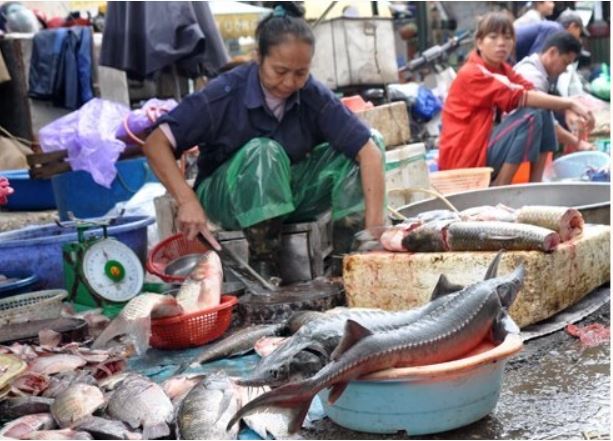
Chinese fish labeled as Vietnamese.
According to a survey by reporters, Chinese sturgeon, snakehead fish, and frogs are currently widely sold in Hanoi’s markets. At Yen So wholesale market in Hoang Mai district, Chinese snakehead fish and frogs are priced from 70,000 to 75,000 VND/kg. After being distributed to smaller markets, the smuggled frogs and snakehead fish are “labeled” as Vietnamese products and their prices are inflated to 100,000 to 120,000 VND/kg.
At Nghia Tan market in Cau Giay district, several shops sell sturgeon for around 170,000 VND/kg. We stopped at one stall, and the owner enthusiastically said, “Buy some sturgeon, sir! It’s farmed in Sa Pa, only 165,000 VND/kg.” “Why is Chinese sturgeon so expensive?” I asked. “There’s no Chinese sturgeon here; we only sell sturgeon from Sa Pa.”
“A few days before the April 30th holiday, the price was cheap at 140,000 VND/kg, but now it’s scarce and the price has gone up,” the vendor said irritably. Ms. Dung (residing in Nghia Tan ward, Cau Giay district) decided to buy a 2.5 kg sturgeon for 400,000 VND after some bargaining. “I’ve heard about Chinese sturgeon but I don’t know how to tell the difference, and buying it at the supermarket is too expensive. I’ll just eat it anyway!” Ms. Dung said.
Mr. Nguyen Trong Cu, Director of Viet Duc Investment and Trading Co., Ltd. (specializing in the production and trading of commercial sturgeon in Tam Dao district, Vinh Phuc province), said: Approximately 13 tons of Chinese sturgeon are smuggled into Vietnam every day. Wholesale markets in Hanoi currently sell sturgeon for 120,000 – 140,000 VND/kg; while smaller markets sell it for 155,000 – 170,000 VND/kg.
“We’re already selling wholesale at the farm for over 170,000 VND/kg. So, I can confirm that any markets selling sturgeon at that price are selling Chinese sturgeon… The sturgeon are transported in refrigerated trucks from Mong Cai (Quang Ninh) to Hanoi; in some areas, Chinese people even come to our country to openly deliver the fish. So where are the quarantine agencies and relevant authorities that they aren’t stopping this?” – Mr. Cu said angrily.
Potential pathogens
On the afternoon of May 6th, Mr. Duong Tien The, Deputy Director of the Aquaculture Department (Ministry of Agriculture and Rural Development), stated that for common aquatic species such as catfish, frogs, and snakehead fish, if they are not invasive species, Vietnam still allows their import. Businesses must declare and complete procedures with customs to obtain a quarantine certificate from the veterinary agency to control disease outbreaks.
However, Mr. The also expressed concern that food products lacking quality control could threaten consumer health. “The use of growth-enhancing feed to raise catfish, snakehead fish, frogs, or other animals can potentially cause genetic mutations. When consumed, people may become ill,” Mr. The warned.
Mr. Do Quang Tung, Director of the CITES (Convention on International Trade in Endangered Species of Wild Fauna and Flora) Management Authority of Vietnam, stated that to date, CITES Vietnam has not granted import permits for commercial sturgeon to any business or individual. Therefore, all Chinese sturgeon present in Vietnam are smuggled.
“Smuggled sturgeon may be raised in industrial environments with substandard, traceable growth-enhancing feed. This poses a risk of disease transmission to domestic consumers, and is even more dangerous than discarded chicken from China,” Mr. Tung said.
Domestic businesses are in tears.
Mr. Vu Van Tam, Deputy Minister of Agriculture and Rural Development, stated that despite considerable efforts, a significant amount of sturgeon and other fish and shrimp species are still being smuggled across the northern border without proper control. In reality, the amount of smuggled goods is much larger than the amount seized and processed by authorities. According to Mr. Tran Cao Muu, General Secretary of the Vietnam Fisheries Association, most cold-water fish farming and trading businesses are operating at a very limited capacity because they cannot withstand the influx of Chinese sturgeon. “If authorities cannot stop the smuggling of sturgeon, the domestic cold-water fish farming industry will be wiped out,” Mr. Muu lamented. |