

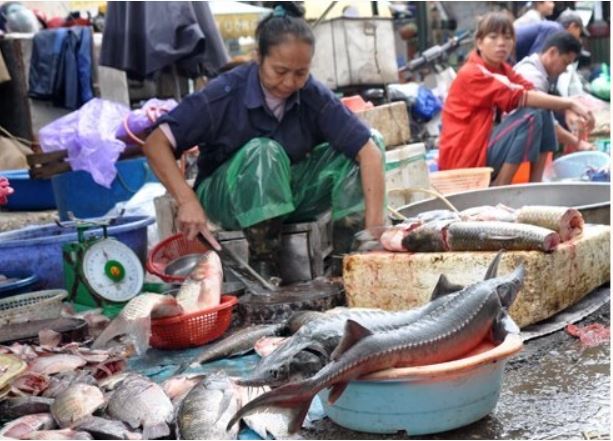
Mr. Duc also stated that the sturgeon at Metro may have origin documents from Lao Cai, but the farms there don’t actually raise them. “I once visited a sturgeon farm in Bac Giang. This farm only had a few dozen cubic meters of water, enough to raise a few dozen sturgeon, but they still issued invoices for 3-5 tons a day,” Mr. Duc cited as an example.
Mr. Nguyen Trong Cu, Director of Viet Duc Company – the sole supplier of sturgeon fry in Northern Vietnam – also stated that he had observed Metro’s sturgeon tank and confirmed that the fish were from China, as they are a hybrid breed.
Speaking with VnExpress.net on the morning of July 8th, Mr. Khuat Quang Hung, Metro’s media representative, affirmed that all sturgeon in their warehouse have import documents from domestic suppliers. “Currently, there are three suppliers of sturgeon to Metro. All products we sell have invoices, documents, and guarantees of origin from the suppliers,” Mr. Hung asserted.
According to him, in the northern region, Metro imports goods from Hanoi Import-Export Services Co., Ltd. (Hasimex) and Hieu Ngan Food Co., Ltd. The goods originate from the provinces of Lao Cai, Son La, and Yen Bai. Currently, both Metro Hoang Mai and Metro Thang Long are selling sturgeon at a listed price of 197,000 VND per kilogram.
In the South, this unit purchases through two suppliers with the goods originating from Di Linh district, Lam Dong province. However, Mr. Hung said that Metro will conduct inspections, even visiting the farms to verify the source of the goods being sold as accurately as possible.
In Ho Chi Minh City , a representative from Big C supermarket stated that they do not sell sturgeon because consumers have little interest in it. A representative from Co.opmart supermarket also said they have only been selling sturgeon for about three months and are testing it in 4-5 supermarket chains. Due to weak demand, each supermarket only sells 8-10 kg per day. The product is supplied by Mai Trang Company in Lam Dong. The supermarket representative added that they have no intention of stopping sales of the product because it has a clear origin and certification.
Meanwhile, at Lotte Mart, a supermarket representative said they stopped selling the product about a week ago due to suspicions that it originated from China. “Although the supply to the supermarket comes from suppliers in Da Lat, it’s very difficult to determine with 100% certainty whether it’s domestically produced or if Chinese fish has been mixed in,” the representative said. Lotte previously sold sturgeon to consumers for 320,000-350,000 VND per kilogram.
Mr. Phan Hoang Kiem, Head of the Ho Chi Minh City Market Management Department, said that the department had just received the information and was reviewing and gathering more data. This week, the department will coordinate with the fisheries sector to clarify the information and plan an inspection.
A leader of the Hanoi Market Management Department also stated that in the near future, they will inspect several supermarkets selling sturgeon to clarify the product’s origin.
At the meeting on July 7th, experts and businesses presented more data proving that the smuggling of sturgeon is quite serious. Mr. Tran Van Hao, Chairman of the Lam Dong Coldwater Fish Association, cited that domestic aquaculture units supply 2-3 tons of commercial sturgeon to the market daily, however, current consumption reaches 10-16 tons.
Previously, Mr. Do Quang Tung, Director of the Vietnamese Agency for the Implementation of the Convention on International Trade in Endangered Species of Wild Animals and Plants (CITES), also affirmed that the agency had never granted import permits for commercial sturgeon to any unit or individual.
Regarding product quality, Mr. Nguyen Nhu Tiep, Director of the Department of Quality Management of Agricultural, Forestry and Fishery Products, said that the Hanoi branch of the department had taken 30 samples of sturgeon, catfish, and snakehead fish sold in Hanoi markets for testing. The results showed that one sturgeon sample and one catfish sample were contaminated with the antibiotic Leuco Malachite Gree; and two snakehead fish samples were contaminated with banned chemicals and antibiotics such as AOZ.


2 Comments
John Doe
Aenean arcu metus, suscipit ac sagittis vel, varius vulputate purus. Vestibulum eget felis at ipsum suscipit elementum eget a nulla. Curabitur auctor dignissim vestibulum. Praesent vel imperdiet nunc, sit amet venenatis sapien. Aenean quis varius nibh, vel egestas metus. Aenean blandit varius lacinia. Praesent imperdiet egestas aliquet. Integer luctus ex quis feugiat malesuada.
Jake Smith
Quisque metus metus, vulputate ut rutrum nec, tempus ut quam. Fusce ultricies nulla vitae odio fringilla faucibus. Phasellus id metus dui. Aliquam erat volutpat. Curabitur sit amet felis vitae nibh facilisis suscipit. Phasellus at urna non enim egestas molestie. Sed porta tristique ex, vel iaculis lorem bibendum et. Donec iaculis arcu neque, at mattis nisi lobortis in.