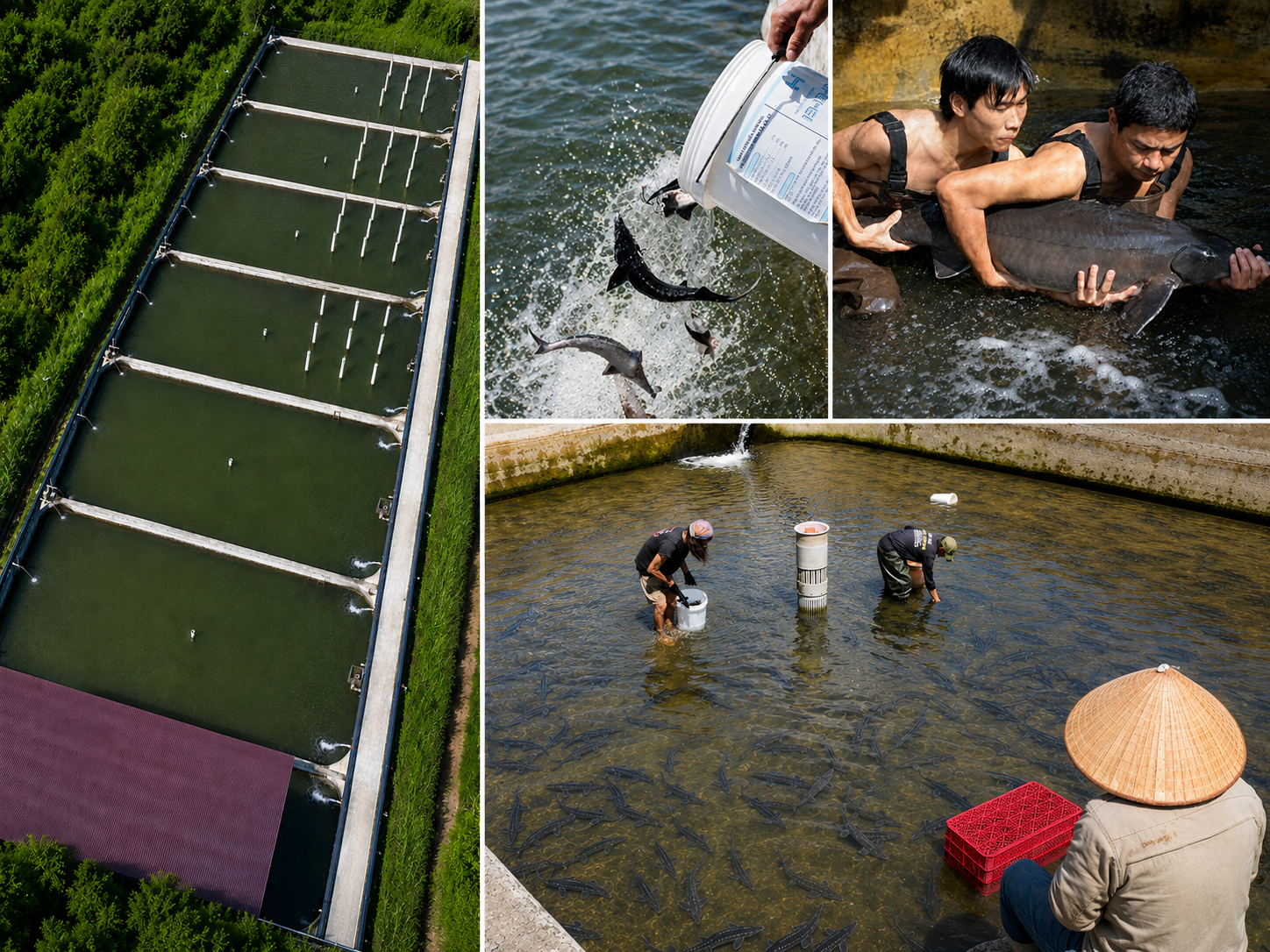
Nguyen Trong Cu’s fish farm is located right next to Xa Huong Lake, at the foot of Tam Dao Mountain. Crystal-clear spring water flows continuously throughout the day, circulating to supply dozens of fish ponds. There are all generations of sturgeon, from newborns the size of a pencil tip to five-year-old “veterans” weighing several tens of kilograms.
I asked a local resident near the fish farm about his work, and she smiled broadly, saying, “This man in the white shirt and collar is even more hardworking than us farmers.” I thought to myself, “She must be praising the handsome owner too much,” but witnessing a day in Nguyen Trong Cu’s life at the fish farm, I was truly astonished. He’d been eating Western food for 30 years, yet he never touched a drop of dairy. Every morning, he’d arrive at the farm, park his BMW 745 by the fence, roll up his sleeves, and throw himself into the farming work, meticulously attending to every detail.
Quang, a fisheries engineer who has worked at the fish hatchery for three years, said: “I don’t know when Mr. Cu taught himself, but there are many things we still have to learn from him.” Bringing cold-water fish (like sturgeon and salmon), which are traditionally farmed in the West, to Vietnam is a miracle for the fisheries industry; and Nguyen Trong Cu played a significant role in this.
A Vietnamese expatriate from Germany, Nguyen Trong Cu bought a house in Hanoi’s Old Quarter near Hoan Kiem Lake, but he was captivated by the forests and mountains. He ventured all the way to Sa Pa and Tam Dao to explore and develop a cold-water fish farming business. Driven by his passion, Cu, formerly a Western-educated lawyer, has become one of the largest fish farm owners in northern Vietnam, capable of engaging in lengthy conversations about fish with even the most seasoned aquaculture experts.
Ha Huong
Pioneering the opening of a new profession.
Mr. Cử’s passion for fish farming stemmed from a mindset of eagerness to learn, a constant drive to adapt to new things, and a love for risk. From a scientific research result, little known outside the field, confirming that salmon and sturgeon could be farmed and developed in Vietnam, Nguyễn Trọng Cử seized the opportunity and dedicated himself to making it a reality. The author of this research was Dr. Lê Thanh Lựu, former Director of the Research Institute for Aquaculture I, whom Mr. Cử still respectfully calls “Teacher” to this day.
Investing in this field is quite expensive, both financially and in terms of effort. Typically, 1 kg of sturgeon eggs costs around 150 million VND. Therefore, the total investment for farming must amount to tens of billions of VND. So, without passion, few people dare to pursue this.
Then, Nguyen Trong Cu traveled to sturgeon farms in Germany and other European countries to learn about sturgeon farming. By chance, he met Udo Gross, the owner of a German sturgeon farm. His family company, Rhoenforelle, had a 130-year tradition of raising salmon and sturgeon. Udo Gross followed Nguyen Trong Cu to Vietnam and passed on his expertise. Simultaneously, Rhoenforelle became a supplier of sturgeon fry to Nguyen Trong Cu’s company.
Upon returning to Vietnam, with the assistance of the General Department of Fisheries and CITES (Vietnam’s management agency implementing the Convention on International Trade in Endangered Species of Wild Animals and Plants), Nguyen Trong Cu and his colleagues confidently began their project.
The biggest challenge in importing salmon and sturgeon roe into Vietnam lies in the cumbersome and time-consuming procedures. To bring 1 kg of roe into the country, close coordination with the German partner is required regarding the fertilization schedule to ensure thorough preparation for receiving the roe. Simultaneously, an import permit issued by the General Department of Fisheries is necessary, followed by inspections by CITES Germany and CITES Vietnam, quarantine permits in Germany and Vietnam, and then expedited customs clearance; otherwise, the roe will spoil, resulting in significant losses. Furthermore, the journey from Noi Bai Airport to Sa Pa is fraught with danger and risk.
However, despite numerous difficulties and hardships, Viet Duc Investment and Trading Company Limited has become a pioneer in hatching and raising two breeds of Russian sturgeon using imported eggs in Sa Pa (Lao Cai), opening up prospects for high-quality aquaculture in the mountains. Following that success, in 2011, Nguyen Trong Cu decided to continue implementing the sturgeon farming project in Tam Dao (Vinh Phuc).
Mission to combat illegal fishing
Today, Nguyen Trong Cu’s fish fry has become the number one choice for fish farmers, not only in the North. From Sa Pa and Tam Dao, sturgeon “made by Trong Cu” has ventured all the way to Tam Duong (Lai Chau) with “contemporary” Tran Yen, or even to Da Lat with the Lam Dong Coldwater Fish Farmers Association…
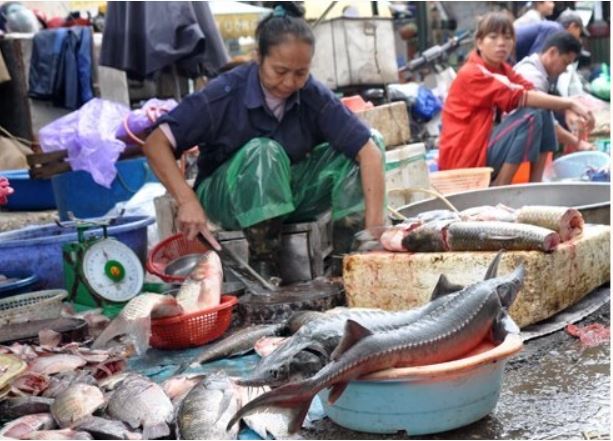
Besides supplying fish fry, Nguyen Trong Cu’s Viet Duc Company also deals in commercial fish, engaging in a life-or-death battle with smuggled Chinese sturgeon, which are often sold at half the price. Meanwhile, as PLVN previously reported, according to Do Quang Tung, Director of the CITES Management Authority, smuggled sturgeon into Vietnam poses a health risk no different from discarded chickens.
“When I started raising fish, I thought I only had to deal with technological issues, but I never imagined I would now have to face the competitive tactics of smugglers,” Cử confided. Many times, feeling exhausted and lonely in this “battle,” he and many other legitimate fish farmers considered giving up. But it wasn’t just about capital and money; it was their self-respect and patriotism that motivated them to continue fighting to push back against illegal fish farming.
With that idea in mind, in early 2013, Nguyen Trong Cu decided to invest billions of dong to open another restaurant, Thac Bac – Sa Pa, at 44 Nguyen Thi Dinh Street, right in the heart of the Trung Hoa – Nhan Chinh urban area of Hanoi, in order to promote the brand of local fish and create a “destination” for diners who love sturgeon and salmon, where they can enjoy fresh, authentic salmon and sturgeon and be assured of their origin.
Tran Yen, a fish farmer and forest planter in Tam Duong, and the owner of a fish farm, wrote a widely publicized “open letter” appealing to Minister of Agriculture Cao Duc Phat to crack down on the illegal “laundering” of smuggled Chinese sturgeon. He shared: “Cua is a decisive and trustworthy person. We feel very secure standing together in the same trenches.”